📌 Early Literacy Part 3: Teacher Tips
Intentional Early Literacy:
What Does It Look Like?
Early literacy instruction for three-, four-, and five-year-olds doesn’t need to take over the preschool day. It can happen in short moments, for example, during a rhyme, while reading a book, as children move, in a conversation, or when a child is ready to try something independently.
The teacher’s role is an active one: model, invite, wait, listen, respond, and revisit. The goal isn’t to turn every interaction into a lesson. It’s to recognize the moments when a little intentional teaching can help a child make the next connection.
Tip # 1. Start with Something Children Already Enjoy
A familiar nursery rhyme can do a lot of work. Take Johnny, Johnny Jingles. Begin by enjoying the rhyme. Let children hear it, echo it, and become familiar with its rhythm and language.
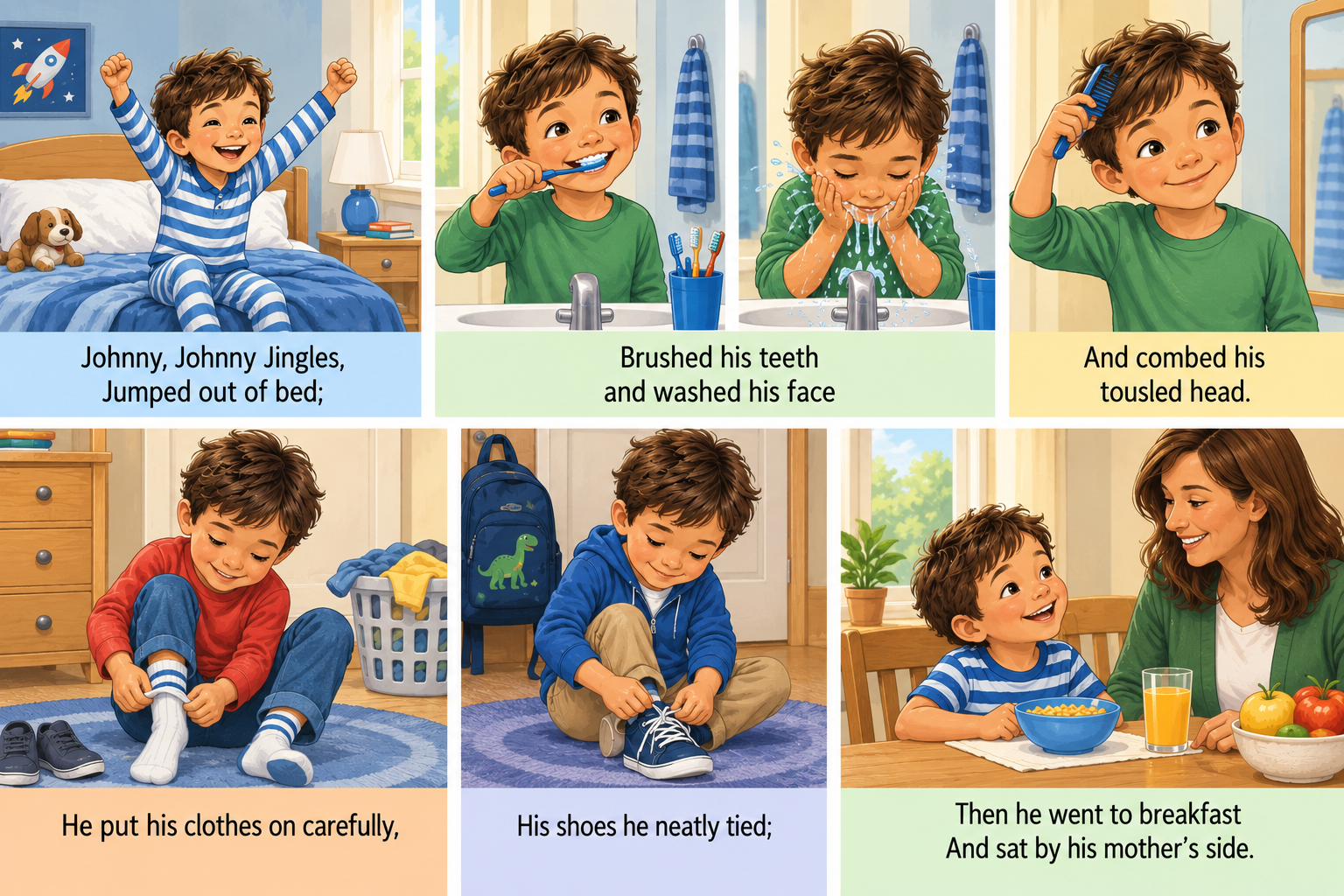
Johnny Johnny Jingles
Then, at another point, draw their attention to the /j/ sound in Johnny and jingles. Say the sound clearly. Listen for it together. Think of other words that begin the same way. When children are ready, connect that sound to the printed J or j. The rhyme hasn’t stopped being a rhyme. You’ve simply helped children notice something within it that they might not discover on their own.
Tip # 2. Let Them Move
Young children don’t have to learn letters sitting at a table with a pencil.
They can skywrite. Walk a letter path taped on the floor. Make a letter with their arms or a ribbon. Trace a textured letter. Draw in sand.
As children form a letter, connect the movement to language they already know. Here is an example of tracing a large lowercase h while saying:
“H spells /h/. Tall line goes down, then bounce one time.”
The child is seeing the letter, hearing its sound, saying what is happening, and feeling the movement used to form it. Later, that same movement can become smaller and more precise as the child is ready.
Tip # 3. Make Print Visible Without Interrupting the Story
Shared reading offers natural opportunities to help children discover how print works. Point to the title before you begin. Track one familiar line while the children recite it. Invite a child to find where reading starts or turn the next page.
Write down something a child says, then read it back: their spoken words have become written words.
Signs, labels, names, menus, lists, and classroom charts can do the same thing during everyday activities and play.
You don’t need to stop a good story to quiz children about print. A few purposeful comments, gestures, and invitations can make print increasingly visible while preserving the experience of reading together.
Tip #4. Put New Words Into Action
Vocabulary grows when children have opportunities to do something with new language.
Consider relational words such as above, below, beside, between, before, and after. Instead of explaining the word and moving on, make its meaning visible.
Put a character under a chair. Move before or after a beat. Ask children which event happened first. Act it out. Talk about it. Use the word again later during centers, outdoor play, art, meals, or another story.
And when a child offers language, build on it rather than replacing it:
“Yes, the spider climbed. It climbed upward beside the spout.”
Tip #5. Adjust the Response, Not Necessarily the Idea
Children in the same classroom will not always be ready for the same response.
One child may participate in a sound activity by listening and imitating. Another may identify the first sound in a word. Another may be ready to blend two or three sounds or begin supported segmentation.
The same is true for writing, language, and print. One child may make large letter movements while another forms a letter more precisely. One may name something in a story while another explains or retells what happened.
That doesn’t require abandoning the activity or creating a different lesson for every child. The teacher can change the level of support or the expected response while preserving the idea being taught.
Tip #6. Notice, Then Decide What Comes Next
Assessment with young children doesn’t always need to look like assessment.
Notice who joins the rhyme. Who recognizes the sound you’ve taught? Who can blend an oral word? Who recognizes a familiar letter? Who handles a book appropriately? Who follows a concept word or begins using new vocabulary?
One response doesn’t have to mean mastered or failed.
Instead:
Notice the response → Identify the next reachable step → Change the support → Observe again.
That small cycle gives the teacher information that can immediately shape instruction.
Finally… Keep It Brief. Keep It Purposeful.
Intentional teaching with young children doesn’t have to mean longer lessons or more formal instruction.
It can mean knowing what you want children to notice, modeling it clearly, giving them a chance to participate, and then returning the learning to conversation, books, movement, music, art, routines, and play.
Model. Invite. Wait. Listen. Respond. Revisit.
That may be one of the best descriptions of the early-literacy teacher’s role.
Wrapping up: As we wrap up, …
Next up: In the final post of this series, we pull it all together: the research, classroom experience, teacher strategies, and consider some next steps.

In Focus explores the concepts that matter most in structured literacy. Each topic examines the research, shares classroom experience, offers practical teaching strategies, and brings it all together the CRSL Way.