🔎 Early Literacy Part 1: The Science
What Does Early Literacy Really Look Like for Ages Three to Five?
Definition and Major Finding
Early literacy is the development of the language, sound awareness, alphabet knowledge, print understanding, and early writing skills that prepare young children for later reading and writing. For children ages three to five, that preparation should look different from formal reading instruction in elementary school.
Early childhood education has sometimes been framed as a choice:
protect play and child development, or,
begin explicit literacy instruction.
Research points to a more integrated approach. We don’t have to choose.
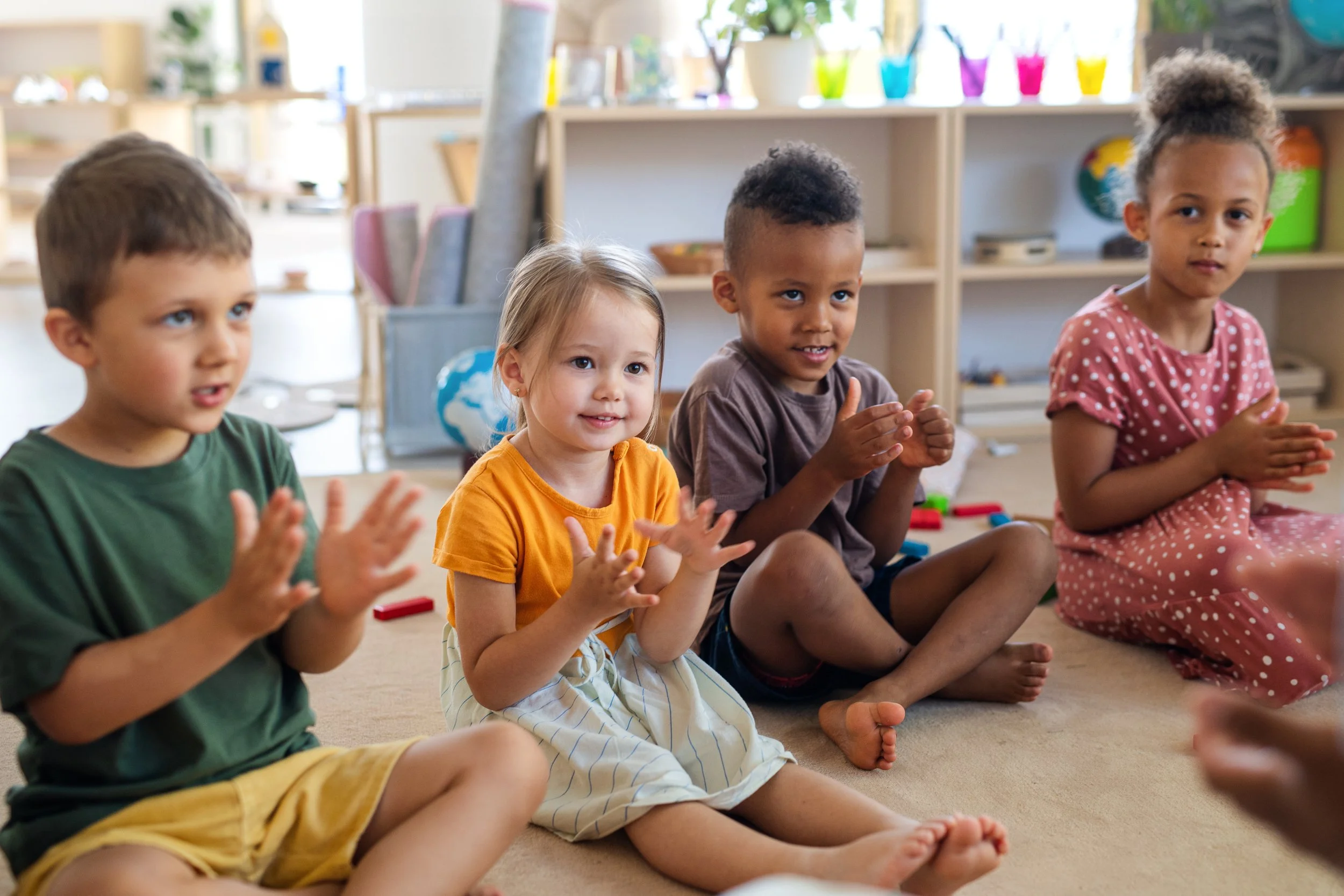
High-quality early literacy can be intentional, relational, active, and brief. Children can listen, speak, move, play with language, notice sounds, begin connecting sounds with letters, handle books, explore writing, and use new words in meaningful conversation and play, while teachers provide brief, explicit, carefully scaffolded instruction.
Guided play and explicit instruction can serve complementary purposes. The important questions are what we teach, how we teach it, and whether our expectations match the child’s developmental readiness.
For a deeper look at the research behind these findings, see the CRSL white paper, Early Literacy for Children Ages Three to Five. Research points to five connected areas that help build a strong foundation for later reading and writing:
Oral Language & Vocabulary
Phonemic Awareness
Alphabet Knowledge
Movement & Early Writing
Concepts of Print
These areas don’t develop in isolation. Together, they help children connect spoken language, sounds, letters, movement, and print as their understanding of written language grows.
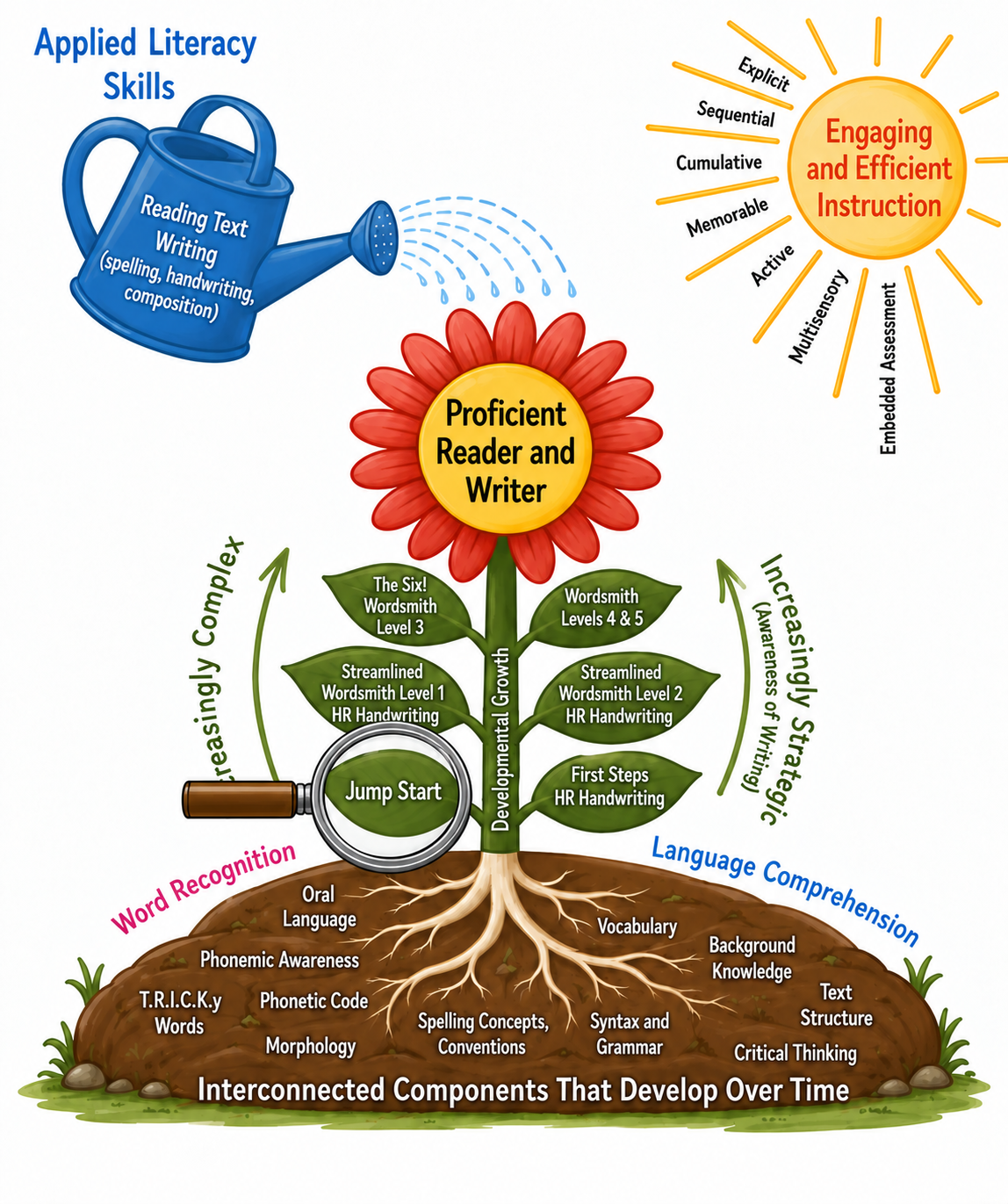
As we unpack each finding, we’ll use CRSL’s Jump Start to Literacy, an early literacy program for children ages three to five, to show what it can look like when these research findings are put into practice in a developmentally appropriate program, as we answer the question:
What does the science tell us young children need in order to build a strong foundation for reading?
1. Oral Language & Vocabulary
💬 The Science Says: Children need opportunities to develop language through interaction.
Oral language is foundational to later literacy development. Young children build language as they listen, speak, explain, retell, ask and answer questions, follow directions, and encounter new vocabulary.
Simply hearing new words is not enough. Children benefit from responsive conversations, clear explanations, repeated encounters with words, and opportunities to use new language themselves. These experiences help children build both vocabulary and the broader language knowledge they will eventually bring to reading.
🔸 Our Approach:
Oral language should be woven throughout the child’s day rather than treated as a separate vocabulary lesson. Teachers can use nursery rhymes, stories, songs, conversation, and play to introduce and revisit language. In Jump Start, teachers talk about what is happening, act out meanings, ask genuine questions, expand children’s responses, and help them connect new words and concepts to experiences they already understand.
New language can then reappear during centers, outdoor play, meals, art, dramatic play, and later stories. Language grows through use. Young children need many opportunities to use it.
2. Phonemic Awareness
💬 The Science Says: Children need to discover that spoken words are made of individual sounds.
Rhymes, songs, alliteration, and other forms of word play help young children become attentive to the sounds of language. But enjoying rhyme and recognizing rhyming words are not the same as being able to hear and work with individual phonemes.
Research supports giving children intentional opportunities to listen for and manipulate individual sounds. For young children, this develops gradually—from listening and imitation to recognizing sounds, identifying beginning sounds, blending sounds into words, and eventually segmenting simple words.
🔸 Our Approach:
Sound awareness can begin within the playful language that belongs naturally in an early childhood classroom.
Nursery rhymes, songs, stories, pictures, gestures, and playful interactions create an inviting context for listening to language. Within those experiences, teachers can deliberately draw children’s attention to the individual sounds they are hearing.
The expectations change as children develop. Younger or less experienced preschoolers may listen, imitate sounds, recognize familiar sounds, and notice words that begin alike. As children are ready, they can begin identifying first sounds, blending two or three sounds into a word, and segmenting simple words into their individual sounds.
Jump Start puts this progression into practice by moving from playful listening experiences toward increasingly intentional attention to phonemes while keeping the learning active and developmentally appropriate.
The play remains. The listening becomes more purposeful.
3. Alphabet Knowledge
💬 The Science Says: Knowing the alphabet involves more than naming letters.
Children gradually build a network of information around each letter. They learn its name, recognize its visual form, learn how it is formed, and connect it with the sound or sounds it represents.
These letter-sound connections are especially important because they begin linking two systems children have been developing: the sounds they hear in spoken language and the symbols they see in print.
Young children benefit from repeated encounters with letters rather than a single introduction followed by an expectation of mastery.
🔸 Our Approach:
Young children benefit from encountering letters repeatedly and from different perspectives, adding new knowledge to what is already familiar.
Jump Start puts this into practice through four instructional cycles:
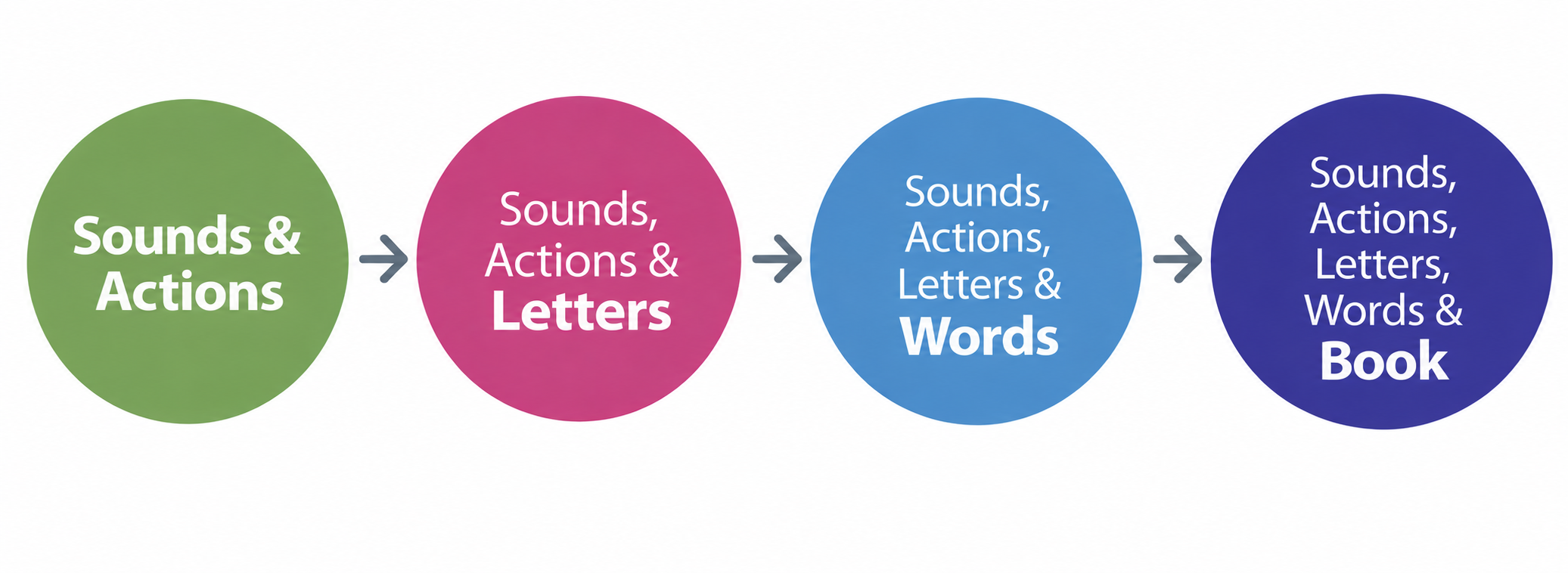
Children first build familiarity with sounds and actions. Later encounters connect those sounds with letter forms, words, and eventually books and print. The alphabet is not something children encounter once and then leave behind. Knowledge grows as they revisit familiar information from a new perspective. Each encounter strengthens the connections among sound, letter, movement, word, and meaning.
4. Movement & Early Writing
💬 The Science Says: For young children, learning letters is physical as well as visual and auditory.
Writing a letter requires more than remembering what it looks like. A child must learn where the movement begins, which direction it travels, and which sequence of strokes produces the letter.
Early writing experiences add a motor pathway to the visual and auditory information children are already learning. For young children whose fine-motor control is still developing, large movements can provide an appropriate starting point before smaller, more precise letter formation is expected.
🔸 Our Approach:
In Jump Start, letter formation begins big. Children may make a letter in the air with broad arm movements, follow modeled strokes, trace tactile forms, or use other large-motor experiences before being expected to form a small letter independently with a pencil. At the same time, children hear and say the sound associated with the letter.
Seeing. Hearing. Saying. Moving.
As children’s control develops, those large movements can become increasingly precise. The goal is not simply handwriting practice. Movement becomes another way to strengthen the child’s developing knowledge of a letter—its shape, formation, and sound.
5. Concepts of Print
💬 The Science Says: Children need to discover how written language works.
Before conventional reading begins, children are developing important understandings about print: that print carries a message, that books have an order, that English text generally moves from left to right and top to bottom, that spaces help separate words, and that spoken language can be written down and read again.
These concepts do not have to be taught as isolated skills. Research supports drawing children’s attention to print within authentic experiences with books, shared reading, and writing.
🔸 Our Approach:
Print concepts can be taught within meaningful encounters with books and written language. A teacher might point out a title, track a familiar rhyme, ask a child to show where reading begins, or write down something a child says and read it back. Jump Start embeds these kinds of interactions in shared reading and classroom experiences so children increasingly notice how print works without interrupting the meaning and enjoyment of the experience.
Together, these five foundations help prepare young children for the reading and writing that comes next.
Join us next for part 2 of this series, as CRSL president and owner, Cheryl Campbell, shares what she has learned about preparing young children to read while keeping learning playful, intentional, and developmentally appropriate.
Resources & Further Reading: link to the white paper

In Focus explores the concepts that matter most in structured literacy. Each topic examines the research, shares classroom experience, offers practical teaching strategies, and brings it all together the CRSL Way.