🔎 TRICKy Words Part 1: The Science of Reading
🔎 In Focus explores the key concepts that shape effective structured literacy instruction.
Part 1: The Science
Part 2:In the Classroom
Part 3: Teacher Application
Part 4: Bringing It Together
🔎 T.R.I.C.K.y Words
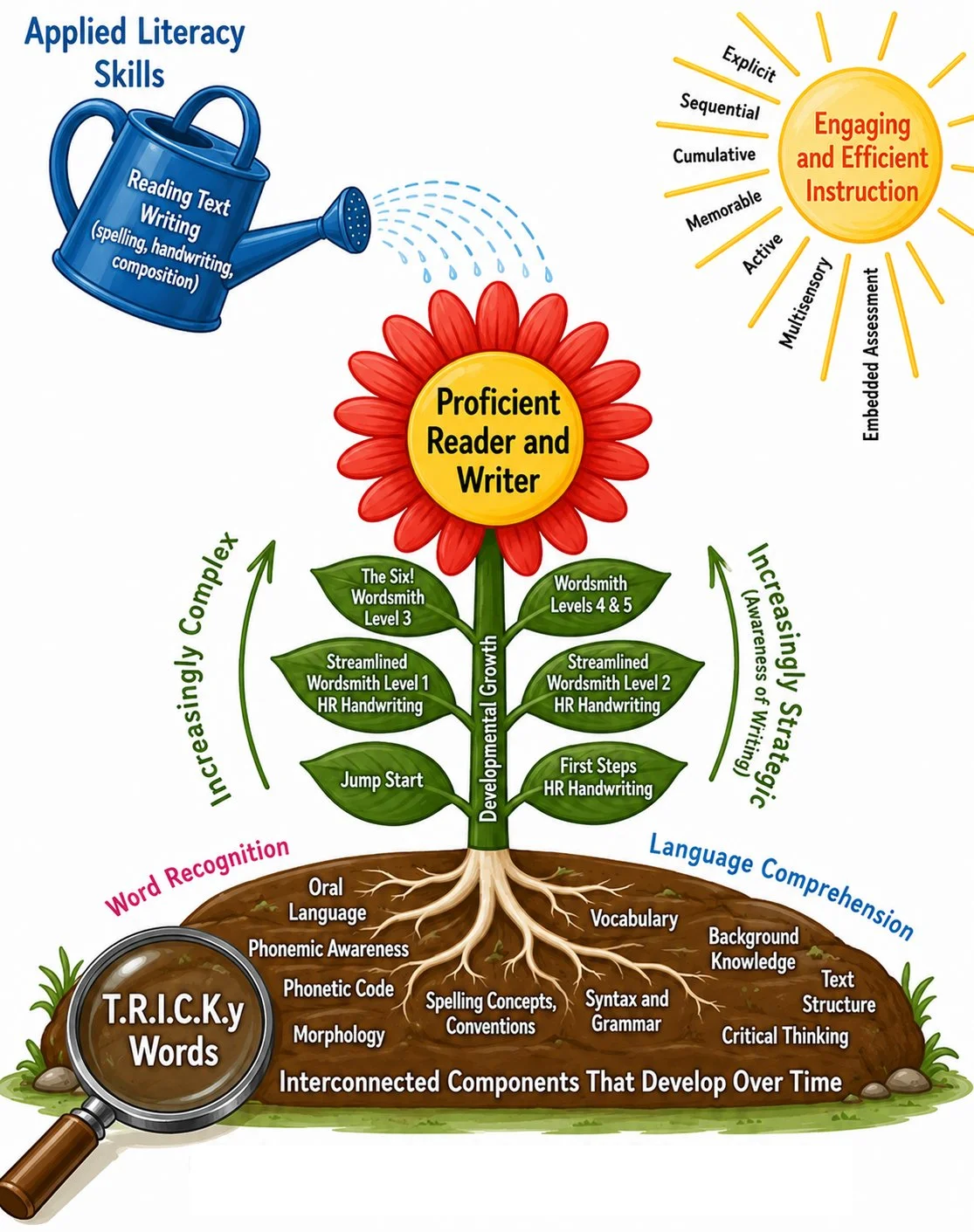
CRSL Student Outcomes Model
What are T.R.I.C.K.y Words
&
Why Are They Important?
Definitions and Major Finding
The terms sight words, high-frequency words, and tricky words have become interchangeable, but there are important distinctions.
A sight word is any word whose sound, spelling, and meaning have been stored in the brain and can be recognized instantly while reading. For a cardiologist, cardiovalvulitis may be a sight word. For a lawyer, certiorari may be a sight word.
High-frequency words are words that appear often in print, such as the, to, and of.
Tricky words are high-frequency words that either contain irregular spellings (such as of, was, and said) or include phonics patterns students have not yet learned (such as they and away). We call these Red Flag Words.
Red Flag Words are high-frequency words that must be explicitly taught because they are either temporarily tricky or permanently tricky. Our goal is to develop automaticity so that these words become sight words for the students.
“The most frequent 100–300 words in a child's print exposure will typically account for approximately 50%–70% of the words a child reads.” (Green, et al., 2024).
Please note that not every high-frequency word is a tricky or a red flag word. A number of these words such as had, in, if are perfectly decodable, even for the beginning reader. However, many high-frequency words have at least one tricky spelling and present difficulties for the reader. Students need to learn these words in order to develop fluency and automaticity when reading connected text.
Let’s look at the science behind effective T.R.I.C.K.y Word instruction.
Why Should I Not Use Lists to Memorize?
Mapping not Memorization
💬 The Science Says:
“Readers store irregular words in memory by mapping spellings to pronunciations using phonemic awareness and letter-sound knowledge.” Ehri (2014) Colenbrander et al. (2022, 2023)
🔶 The CRSL Way:
We know that the process of orthographic mapping, or storing a word by connecting sounds, letters, and meaning, is crucial for words to become automatic. When we teach Red Flag Words, we first apply meaning to the word and then we listen for the sounds and talk about the spelling for each sound. We note which spelling(s) we must “red flag” because they are tricky.
Why Aren’t All Tricky Words the Same?
Temporary vs. Permanent Irregular Words
💬 The Science Says:
The Science of Reading emphasizes the integration of systematic phonics with teaching sight words. We know that orthographic mapping is enabled by phonemic awareness and letter-sound knowledge. (Ehri, 2014) (Castles, 2018)
🔶 The CRSL Way:
We use the term learn for words whose spellings students will eventually know later, with more phonics knowledge. We use the term remember for words that contain unusual spellings that must be remembered. We also drop the classification of Red Flag Words for words that have become decodable, once the student has learned the phonetic pattern.
For example, in kindergarten, the words no, me, she, he, we, be, go, my are taught as Red Flag Words since the concept of long vowels in open syllables has not been taught. But, in Unit 6 of First Grade, this concept is taught, and these words are now decodable words.
How Do Multisensory Methods Help Teach Red Flag Words?
Building Stronger Word Memory
💬 The Science Says:
Research guides us in knowing that multisensory activities can help student make sound-letter connections and meaning links more effectively than rote memorization. Multisensory approaches include meaning, visual, auditory, and kinesthetic.
🔶 The CRSL Way:
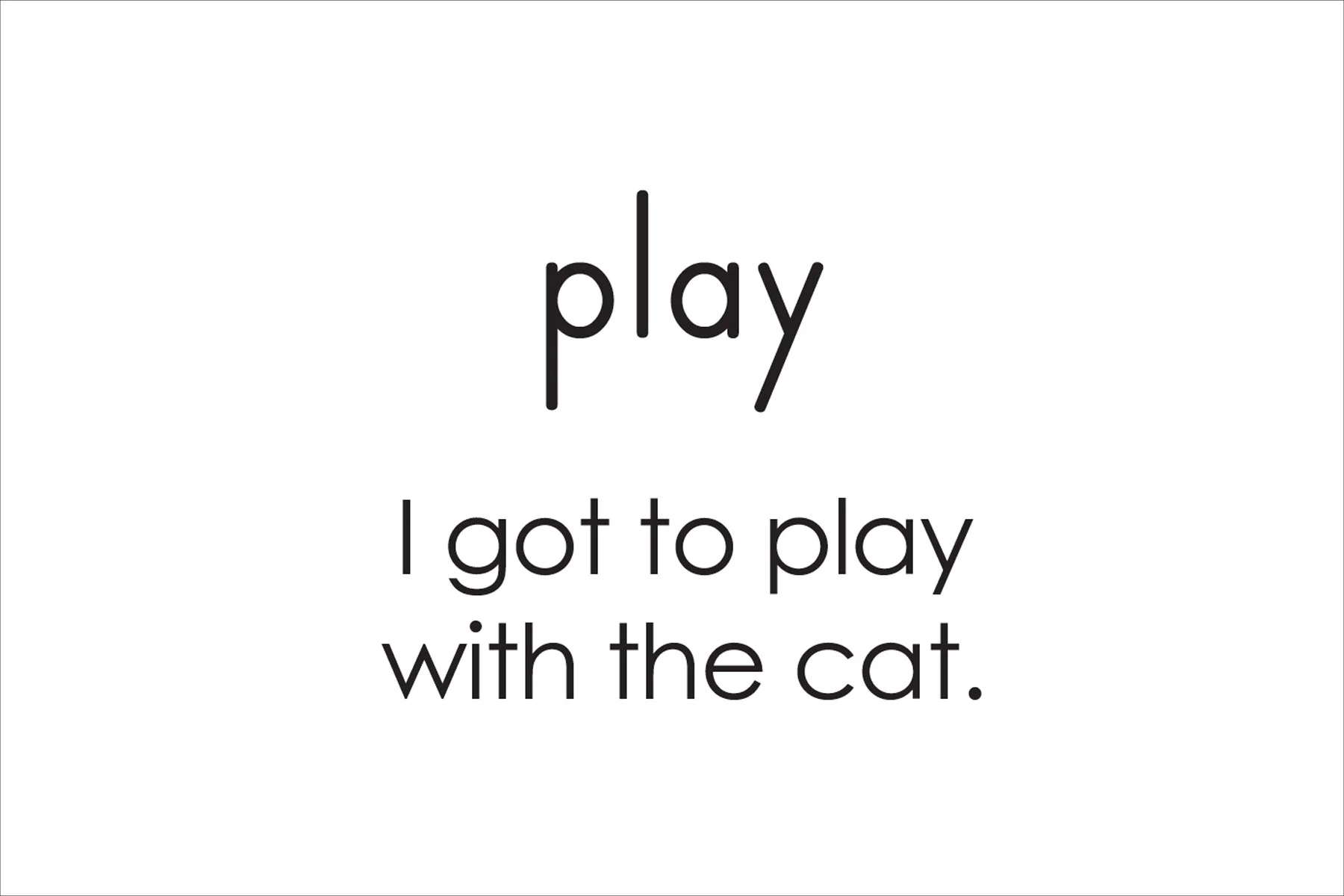
We show the word, discuss its meaning, and read it in a sentence. For example, for the word play, we give a “kid-friendly definition” (to do something you enjoy) and use it in a sentence.
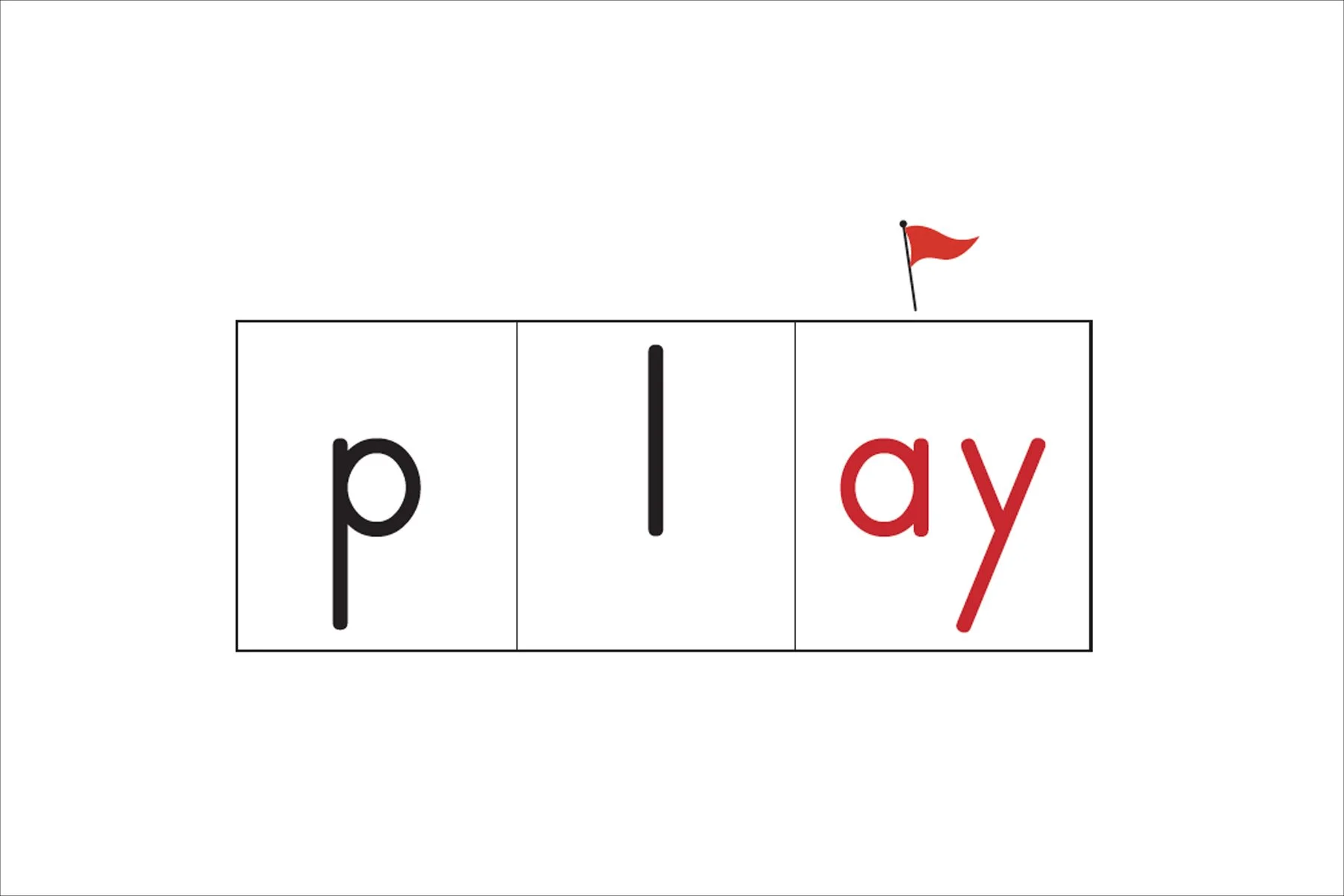
We listen for the sounds (auditory) and show sound boxes for each sound. We then visually examine each spelling and “red flag” it to show the tricky spelling.
Then we kinesthetically study the word while clapping, tapping, etc., while saying the letter names of the word. Another kinesthetic or movement activity is to “sky write” the word and then write it on a dry-erase board.
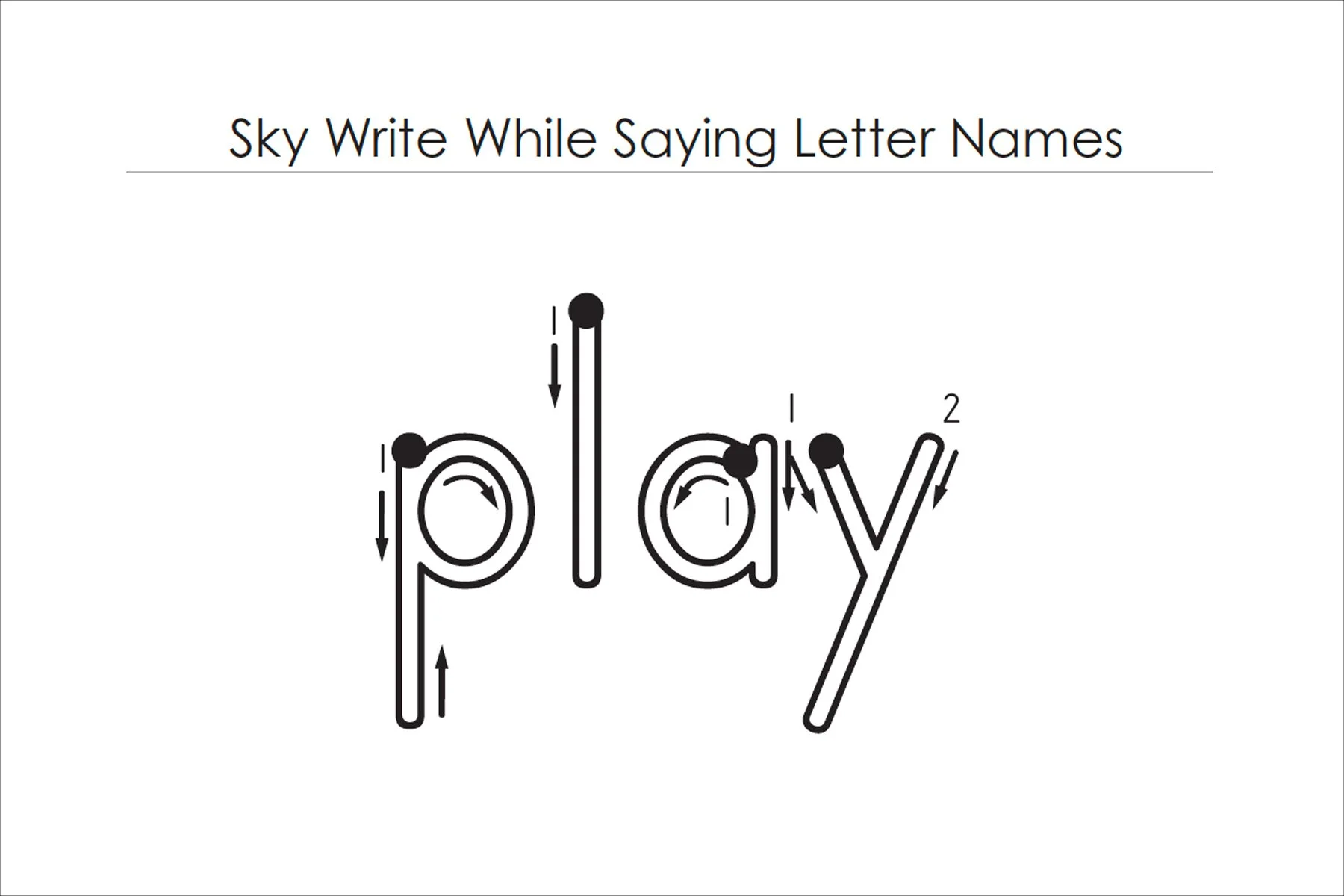
We also use a version of Copy, Cover, Compare method (Conely, 2004). (See Teaching Tips in Part 3.)
Why Should I Compare Words?
Finding Patterns Through Comparison
💬 The Science Says:
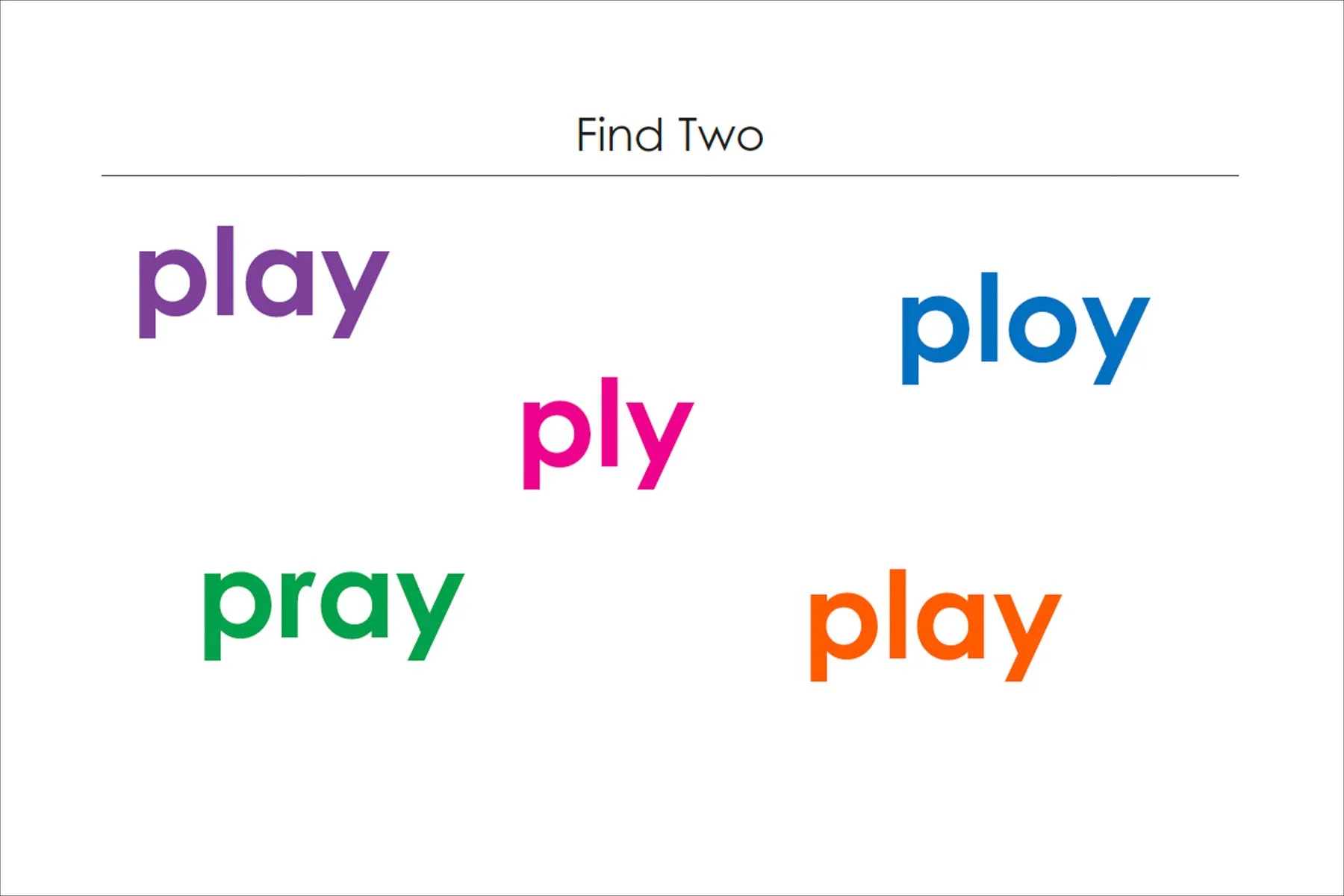
Asking students to compare look-alike words, such as ploy, play, plan, pray, ply can be a highly effective strategy. (Kilpatrick,2016)
🔶 Our Approach:
We visually discriminate between look-alike spellings. When students compare similar words, they have to look at the whole word, examining each letter and pattern. This helps students consider the whole word, rather than guessing by the first letter or the word configuration.
How Should I Choose Red Flag Words?
Teach What’s Truly Tricky
💬 The Science Says:
Research indicates that a small strategic set of irregular words should be taught. (Schwartz, 2025) For years, teachers have relied on Dolch Words, compiled in 1936 and the Fry Words, compiled in 1980. A new list, CPB List (Green, et al., 2024) provides new methodologies in choosing high-frequency words.
🔶 Our Approach:
We follow these principles:
The emphasis should always be on the regularity of the spelling system. Therefore, we teach Red Flag words after the students have had some instruction in basic decoding skills and understand the Alphabetic Principle.
We provide direct instruction for learning these words. We introduce the words gradually.
We choose our words based on high-frequency lists (see above) and also on when the words appear in our decodable books. In order to read these books, students need the necessarily phonics skills for each book and also the ability to read certain Red Flag Words. When we integrate the books and the tricky word instruction, we know that the repeated, accurate practice with connected text will consolidate these tricky words into long-term memory.
Final Thoughts: We know that accurate reading and spelling of high-frequency words is very important. We also know the most effective ways to teach these words:
Connect meaning, sound, and spelling.
Use orthographic mapping to show the regular and irregular parts.
Integrate with phonics. Carefully distinguish between words that will be eventually learned and words that will always need to be remembered.
Provide multisensory explanation and practice.
Always connect to meaning and use in connected text.
Next up: In Part 2 of the series, Cheryl Richards reflects on how her own teaching of T.R.I.C.K.y Words changed as research reshaped classroom practice in Conversations with Cheryl.
Resources & Further Reading
References
Castles, A., Rastle, K., & Nation, K. (2018) Ending the reading wars; Reading acquisition from novice to expert. Psychological Science in the Public Interest,19(1), 5-51.
Colenbrander, D., Kohen, S., et al. (2022). Teaching children to read irregular words. Scientific Studies of Reading, 26(6), 545 -564.
Conley, C., Derby, K., Roberts-Gwinn, M., Weber, K., McLauglin, T. (2004) An analysis of initial acquisition and maintenance of sight words following picture mapping and copy, cover, and compare teaching methods. Journal of Applied Behavior Analysis,37(3), 339-349.
Ehri, L.C. (2014). Orthographic mapping in the acquisition of sight word reading. spelling, memory, and vocabulary learning. Scientific Studies of Reading, 18(1), 5-21.
James, E., Gaskell, M. G., Pearce, R., Korell, C., Dean, C., & Henderson, L. M. (2021). The role of prior lexical knowledge in children's and adults' incidental word learning from illustrated stories. Journal of Experimental Psychology: Learning, Memory, and Cognition, 47(11), 1837–1852.
Green, C., Keogh, K., & Prout, J. (2024). The CPB Sight Words: A New Research‐Based High‐Frequency Wordlist for Early Reading Instruction. The Reading Teacher, 78(1), 56–64.
Kilpatrick, D. A. (2016). Equipped for reading success: A comprehensive, step-by-step program for developing phoneme awareness and fluent word recognition. Casey & Kirsch Publishers.
Rawlins, A., Invernizzi, M. (2018). Reconceptualizing sight words: building an early reading vocabulary. The Reading Teacher, 72(1), 711-719.

This post is part of In Focus: Key concepts that help teachers build confident readers through structured literacy.