📌 Phonemic Awareness Part 3: Teacher Tips
Use Manipulatives for Segmenting and Blending

Phonemic Awareness Activities can be fun and engaging. Try Pinch with P.A.W.S. and Whoosh!
Tip # 1. Pinch with P.A.W.S.
When students segment sounds, they are taught to pinch sounds (touch a finger to their thumb for each sound).

Pinch with Paws is a worksheet activity that guides students to segment sounds correctly and imitates the pinching or segmenting of sounds.
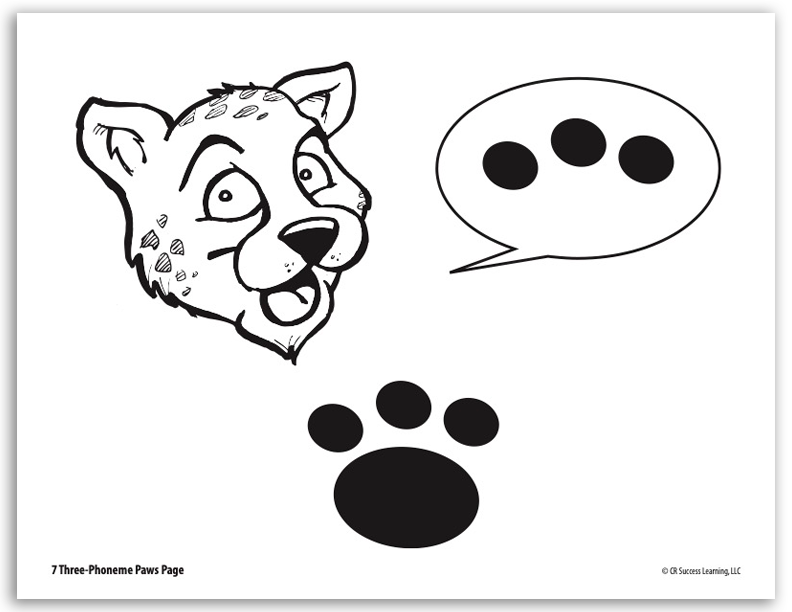
Tell students to put three blocks in Paws’ speech bubble.
“You know how you pinch sounds in words. Paws is also going to pinch sounds. Today, Paws will say a word with three sounds. Then, he will say each sound as he pulls down the blocks, one-at-a-time. Let’s do one together. The word is net. Let’s say the sounds in net.”
Model, saying /n/ as you pull down the first block, /e/ as you pull down the middle block, /t/as you pull down the last block.
“/n/ /e/ /t, net- a fabric with strands woven together; a basketball net is hung from a hoop and the basketball passes through the net.”
Why It Works: This activity is a form of Elkonin boxes, which are a series of boxes, one for each sound (phoneme) in a word. It is a visual and tactile activity that gives students the opportunity to practice segmenting each sound in a word. In this example, it is self-correcting, as the student knows to listen for the correct number of sounds.
Tip # 2. Continuous or One-Breath Blending
This activity, Whoosh!, helps students blend continuously, without pausing or taking a breath between sounds. Here is here you play the game:
Provide each student with a copy of the Whoosh Worksheet and a crayon.
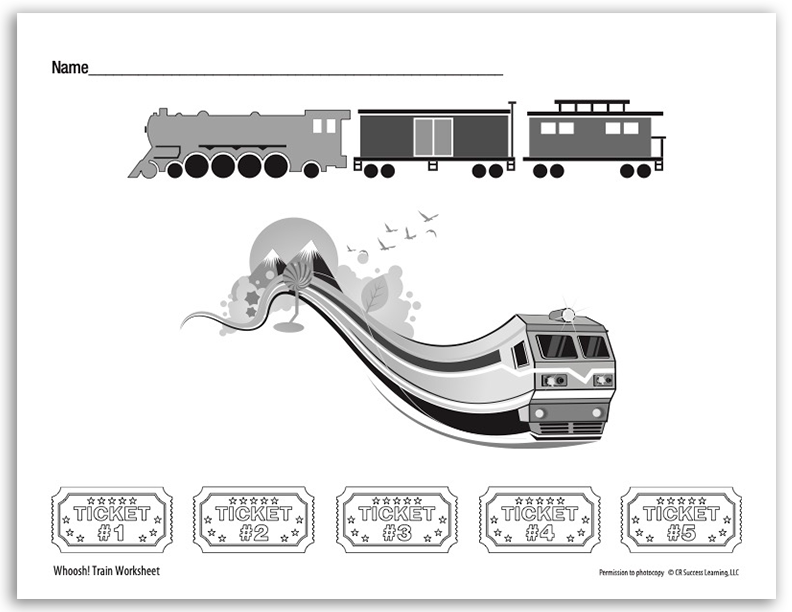
“Today, we will play Whoosh! We will blend sounds fast, in one breath. Let’s do the first one together.”
“Look at the two trains. The top train is a freight train. The train under it is a bullet train, which travels very fast.”
“Look at the freight train. I will say three sounds. You will repeat the sounds as you point to each box on the freight train. /s//i//p/. Let’s do that again. /s//i/ /p/.”
“Now, look at the bullet train. Put your finger under the bullet train and scoop across as you say the sounds fast, in one breath /sip/.”
“What is the word? Yes, sip. It means to drink something in small mouthfuls.”
“You have earned a ticket for blending the sounds to say the word, sip. Color Ticket #1.
You will get five tickets today.”
Repeat the same activity for the sounds and words below. If a word begins with a clipped consonant sound, such as /k/ or /t/, model blending the consonant sound quickly into the vowel.
Ticket #2: /m/ /e/ /t/, met
Ticket #3: /s/ /a/ /p/, sap
Ticket #4: /c/ /u/ /t/, cut
Ticket #5: /t/ /i/ /n/, tin
Why It Works: This approach helps beginning readers who often have problems with working memory, or holding the sounds in their minds, when they say the sounds one-by-one. This method models how to successfully blend sounds and is a transition strategy before automatic blending.
Wrapping up: These two activities (Pinch with Paws and Whoosh!) are two engaging activates that develop segmenting and blending skills, while using manipulatives. Each one is multisensory, involving visual, auditory, and tactile responses.
Next up: In the final post of this series on Phonemic Awareness, we’ll review the topic, pull it all together, discuss why this matters now, show what’s within your reach. Ready to pull it all together?

In Focus explores the concepts that matter most in structured literacy. Each topic examines the research, shares classroom experience, offers practical teaching strategies, and brings it all together the CRSL Way.